
The OLT’s role in Ontario’s Ward Boundary Reviews
Ontario’s population continues to grow. As of October 1, 2025, Statistics Canada estimated the province’s population at 16,191,372, an increase of 886,003 people, when the last municipal elections took place. This growth aligns with the Ontario Ministry of Finance’s population projections, which anticipated Ontario reaching 16.1 million residents in 2024, with continued growth.
Most of the growth earlier in the decade came from immigration. However, Statistics Canada’s latest release shows the province experienced a population decline of 66,888 (-0.4%) between July 1 and October 1, 2025. This drop was driven primarily by changing government policies that resulted in reductions in the number of non‑permanent residents. These rapid shifts illustrate how quickly population dynamics can change and why regular ward boundary reviews are essential for maintaining fair representation in the electoral system.
As new residents settle across the province, some municipalities are growing more quickly than others. To maintain fair representation, municipalities across Ontario may need to revisit and update their ward structures more frequently.
How ward boundaries are updated
Ward boundaries help shape how local democracy works. Reviews are based on various principles, including effective representation, population parity, communities of interest, and a councillor’s ability to represent their constituents.
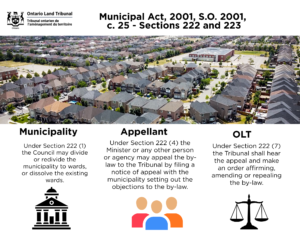
Under Section 222 of the Municipal Act, a municipal council can:
- Divide its territory into wards
- Redraw existing ward boundaries
- Dissolve wards entirely
Any change must be approved by council through a bylaw. A review can be initiated by a municipality or triggered by a petition signed by electors. When a petition is submitted, council has 90 days to pass a bylaw. If it doesn’t, any petitioner may apply to the Ontario Land Tribunal (OLT) under s.223(4) of the Municipal Act. When council does pass a ward boundary bylaw, members of the public also have an opportunity to appeal that bylaw to the OLT within the prescribed appeal period under s.222(4) of the Municipal Act.”
The Tribunal then considers the matter and issues a binding decision. Because ward boundaries directly affect representation, the OLT aims to issue any final orders before December 31 of the year before a municipal election.
Ward boundary appeals before the OLT
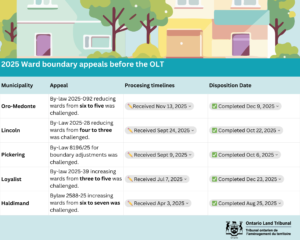
In 2025, the year leading to the 2026 Municipal elections, the OLT received five ward boundary appeals, three more than in 2022. Four of these were submitted between September and November, a period when appeals are common as councils finalize reviews or residents respond to newly passed bylaws.
Given the impact these decisions have on democratic rights, the Tribunal prioritizes ward boundary matters and expedites scheduling, review, and decision making. By the end of 2025, all five appeals were concluded, providing clarity for municipalities, election officials, candidates, and voters.
A look back: Historical quick facts
To understand why the OLT plays such an important role today, it’s helpful to look at how Ontario’s previous tribunals shaped the process.
The Ontario Municipal Board’s decisions (OMB) applied Supreme Court Direction, which became the foundation for ward boundary reviews
Before 2001, provincial legislation did not outline detailed criteria for designing ward boundaries. Municipalities, in turn, relied heavily on Ontario Municipal Board (OMB) decisions, which followed the Supreme Court of Canada’s 1991 decision in Reference re Provincial Electoral Boundaries (Sask.) (the “Carter” case). Carter established that citizens have a Charter‑protected right to effective representation, including relative voting parity, recognition of communities of interest, geography considerations, and the ability for elected officials to represent their constituents effectively.
The OMB applied these principles when adjudicating appeals under section 222 of the Municipal Act, 2001, and its rulings became informal standards and guidance across the province.
An early example of the OMB’s application of the Carter criteria includes Ottawa (City) v. Osgoode Rural Community Association (2003), where the Board examined rural–urban representation imbalances within the newly amalgamated City of Ottawa.
More recently, in a notable 2017 decision (2017 CanLII 85763 (ON LPAT) (the OMB overturned the City of Hamilton’s ward boundary bylaw restructuring Hamilton’s 15 ward boundaries. The OMB concluded the council‑approved boundaries didn’t meet fairness or representation standards. This remains one of the clearest examples of a tribunal fulfilling its role under the Municipal Act to review and reshape a city’s electoral landscape.
LPAT Inherited and continued the OMB’s Authority
When the OMB became the Local Planning Appeal Tribunal (LPAT) in 2018, the ability to amend or repeal ward boundary bylaws remained intact, as did electors’ ability to petition for ward reviews, reinforcing a long‑standing mechanism that allows residents to spark electoral reform from the ground up.
The OLT Carries this legacy forward today
Since 2021, the Ontario Land Tribunal (OLT) has handled these appeals. Although the tribunal’s name and structure changed, its powers under Section 222 stayed the same. The OLT now applies decades of tribunal history to inform its decision‑making on ward boundary matters.
These Decisions have real electoral impact
Tribunal rulings have affected:
- How many councillors municipalities elect
- How neighbourhoods are grouped together, including the shape and size of wards boundaries. These decisions shape how candidates’ campaign and how accessible local representation is in fast‑growing communities.
As Ontario’s population continues to grow and municipalities review their ward boundaries, the OLT’s role remains essential in ensuring fair, local representation for residents. The next Ontario Municipal Elections will be held on Monday, October 26, 2026.


the Government of Ontario.

© King's Printer for Ontario, 2026.
All rights reserved.